I left the classroom after 10 years to make a mid-year move across the country. I took a new position in curriculum development (and new teacher mentorship). During these years, I have written and review a LOT of lesson plans.
Here is free lesson plan template to get you started on writing quality plans. It is an editable Google Doc.
Here are the top 5 lesson planning mistakes I’ve seen:
1. Plans Lack Logical Progression
The first lesson planning tip is to make sure the order of lessons makes sense. Some units are obvious when it comes to ordering the lessons, but others really need some intentional thought.
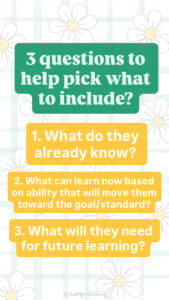
I like to ask myself three questions when deciding what to include an in what order:
- What do the students already know?
- What do they need to know this year to meet standards?
- What do they need to know for the future?
What do the students already know?
This takes some figuring out at the beginning of a unit, but it is always worth doing. I liked to use a quick 10-question assessment at the beginning of a unit to see what students know BEFORE I plan.
Once you know this, you can decide where you need to fill in some gaps and with which students.
What do the students need to know?
Once you know what your students already know, you can make a more informed decision about what lessons to teach to get them to the standards set.
This is where you have to decide which pieces are missing to get them from what they know to what they need to know. Think about small steps that can move them in the direction needed.

What do they need to know for the future?
Sometimes thinking into the future years of the student’s education can feel like a luxury you can’t afford. But taking just a moment to think about how this skill will be called upon in the future is helpful when navigating the planning piece.
For example, knowing that the student will be called upon to use least common multiples for finding common denominators, can be helpful to keep in mind in the planning process. You may even choose to give students a preview of this skill.
2. Failure to Anticipate the Cognitive Load
The next planning mistake I saw frequently, was forgetting that students can only take-in, process, and remember a certain amount of information in one sitting. This is known as the COGNITIVE LOAD of the child, and it varies by age and individual.
Chunking Information
When looking at the skill or objective for a unit or lesson, it is helpful to chunk information together based on similarity.
I find using the formula of “Easy + 1” is helpful in balancing the cognitive load. Let students practice somethings that until it becomes easy and then add more level of difficulty.
Structuring Class Time
Students can increase their cognitive load capacity when the structure of the activity varies within a lesson. One of the best ways to do this is do a little teaching and then give them a little practice. Then come back for a little more teaching and review, then send them off to practice again.
Many teachers will teach and send them to practice, but adding in another cycle of this will boost understanding and retention.
Here’s a sample of what this may look like in a math class:
- 5 min review problem from yesterday
- 10 min lesson
- 5 min short practice
- 10 min lesson & review
- 10 min practice
- 3 min rapid fire review and preview of next day
3. Just "Winging" the First and Last 3 Minutes
The most important 3-5 minutes in each class/subject is the first and the last. And yet… this is where most teachers just “wing it”.
The First 5 Minutes
This the thing that signals to the students that the class is starting. This also sets the pace for the rest of the class. You need something that is quick, but captures their interest and gets them to actually think.

I use these slides in language arts with my class. They love the puzzle and play of these warm-ups, but they change from day to day to keep them engaged. This review also keeps previous material fresh so I don’t have to do a ton of that in the lesson (which disrupts our flow).
One things I see often is that something teachers think is only going to take 5 minutes, ends up taking only 1 minute or ends up taking 20 minutes. It will take some time to find that sweet spot of 3-5 minutes.

The Last 5 Minutes
Research shows that students typically only remember the last 3-5 minutes of the class. This means that those last 3-5 minutes should be used for some form of review from the day. I like to do spit fire review with my sticks of doom (popsicle sticks with each student’s name).
I also like to end the lesson with a question that they won’t know the answer to from today’s lesson, but will know the answer after tomorrow’s lesson. This is like a sneak peak and gives them a little excitement for the next day.
4. Thinking About Just This Year
Writing quality lesson plans takes a lot of time, something that teachers just don’t always have. We tend to jot down a few key things as an outline for the lesson and materials. But then the next year rolls around that simple outline looks like a foreign language, and you’re back to square one!
Quality Lesson Plan Template
Stop telling yourself that you will remember and actually write things down as you plan them. One of the best ways to do this is to have a quality lesson plan format – not too simple, but also not too complicated. You will want to have labeled sections that remind you of details to include when writing the plan.
If this is your FIRST YEAR, you can absolutely teach the lesson and then go back in to add in the details. Your second-year self is going to thank you for any notes you can manage to get down.
Grab a free lesson plan template below (it is an editable Google Doc).
Have a Section for Prep
At the top of the lesson create a section for the list of things to prep. I’m talking about what to print (color, two-sided, etc.), what to laminate, what to cut, what to change, etc.
Give yourself the comprehensive list of what needs to be done so that you don’t have to read the whole unit/lesson next year, hoping nothing slips your skimming.
Write Down Questions to Ask in the Lesson
I always keep a spot in the lesson plan where I put in questions that I am going to ask to lead discussions. This can seem like too small of a detail, but it is one that keeps the quality of the lesson the same from year to year (even when the content of that specific chapter or lesson is a bit hazy since last year).
Link EVERYTHING!
But my number one tip on making lesson plans that work from year to year is LINKS! Every video, set of slides, resource, rubric, answer key, etc. gets linked in the lesson plan/unit plan when it needs to used or prepped.
5. Assuming All Learning will Happen at a Uniform Pace
Each year there is always one lesson that takes me by surprise and proves to be incredibly difficult even though every other year the classes seemed to get it no problem. Every students is unique and therefore, every class is unique.
Leave time in your units for the possibility that something may prove to be challenging to this group. I always planned the unit and then added one day into the plan which I left totally blank. It’s sole purpose is overflow and flexibility.
This isn’t always possible. If you get off track and off the plan, it’s fine! Really! In the 10 years of teaching the same thing, I got to varying points in the curriculum each year. It is natural.