getting students to think using well-crafted questions

Getting Students to Think Using Well-Crafted Questions

I can remember the light-bulb moment as I sat in a professional development session about asking good questions. To be honest, I was rolling my eyes at this topic before the session even started. 

But then the speaker started comparing some questions, and I realized that just about every question I was asking my students this speaker was using as an example of what not to do. Yikes! 

Then she went on to compare and students answers, and I realized I was in trouble…

But one of the coolest things about teaching is that you get a chance to start again and try some new things with each new school year and group of students. So that’s just what I did. 

Here's how I tackled asking better questions and accepting better answers:

Asking Good Questions

Good questions

  • draw upon factual knowledge 
  • examine relationships between ideas
  • require well-reasoned positions (over just feelings and opinions)
But we can forget that questions are our greatest tool to get students to make connections that they may not have made otherwise. Sometimes it’s not about what they know, it’s about an opportunity to think deeply (even if it’s messy to grade). 
Questions about Factual Knowledge

As teachers we do a good job drawing out the factual knowledge that our students have. I think we hang out here because it’s easy to score/grade and see what the students KNOW.

Rudyard Kipling wrote a poem entitled, “I Keep Six Honest Serving Men” about the six questions words that acts as explorers for the young child gathering as much as they can by asking questions. I have my students read, discuss, memorize, and recite this poem as the first assignment of the year. 

Here are some factual question starters: 

  • What are/is…
  • Who are/is…
  • Where are/is…
  • When are/is…
  • How did ____ happen?
  • Why did ____ happen? 

Most factual questions could be multiple choice. If you find yourself asking a question that couldn’t be multiple choice, it most likely not a factual knowledge question. 

Questions that Examine Relationships

These questions are my favorite because they can be absolutely bizzare and lead to the most significant thinking and discoveries. 

Questions directly comparing: 

  • How are pickles and rabbits similar? 
  • How are bubbles and fractions similar? 
  • How is (insert villan) similar to (insert hero)?

After a few of these, your students will be hooked. You will discuss and debate if both pickles and rabbits should be banned from sandwiches or if both should begin their lives outside. Could it be that both make good pets? It is silly. But it is also just the thinking that fuels creative writing. 

Questions indirectly comparing: 

  • What does (insert character) want the MOST? 
  • What is (insert character) MOST afraid of? 
  • Which character is LEAST likely to survive on a desert island? 
  • Which of these essays/answers is the BEST?
These are the questions that spark lively debate and get even the most stubborn students thinking. This is also where is imperative to get them to defend their answers with evidence of some sort. Their feelings alone are not a valid defense. 
 
Questions that Require Well-reasoned Responses

These questions are going to overlap with the last section because a lot of comparing questions will require a well-reasoned defense. 

Here is are some sample responses to the question, “Why are bananas the best fruit for a snack?” 

Good: Bananas are the best snack because they are yellow, and yellow is my favorite color. 

Better: Bananas are the best fruit choice for snack because they taste better than the other fruits and they won’t get your hands messy. They also are more filling than the other fruits. 

Best: Bananas are an excellent source of potassium, a nutrient needed to regulate heart rate and the entire nervous system. With their own biodegradable packaging and long shelf life, bananas make a superior fruit choice for snack. 

Notice how the best answer is using facts and then making a judgement call. There is no opinion formed that is not supported by fact. 

This is not to say that students can’t have preferences or opinions, but most of the time they don’t need extra practice formulating preferences. They do however, need practice having an open mind, hearing facts, determining their position, and then being able to logically and articulately express it. 

Keep the Questions

After you formulate these questions that get you students to think deeply please WRITE THEM DOWN!

If you need a good lesson/unit plan template with a space for questions you can grab my free editable template using the link below. 

Getting Quality Responses

After we feel confident that we have written quality questions, we must train our students to give quality answers. 

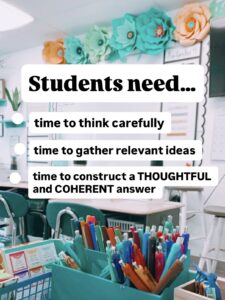
Give Time to Think

Research shows that the number one predictor of students giving quality responses is TIME TO THINK. 

Allow students time to think prior to accepting any oral response. Students can jot down ideas or notes to use, but there should be no raised hands during thinking time. 

Nothing is more distracting to a student trying to think than a room full of other students waving their hands and say “oh oh oh”. A student who doesn’t want to think, will rely on this chorus of hands to carry the load of learning. 
Everyone is Accountable for Learning

I know the sticks with student names get a bad rap, but I swear by them. They ensure that every single student is held accountable for the information taught. 

Sometimes it’s the kid who knows the answer. Sometimes it’s the kid who was completely zoned out. But it isn’t personal- just luck of the draw. 

I refer to them as the sticks of opportunity, but most students have renamed them to the sticks of doom.🤷‍♀️ 

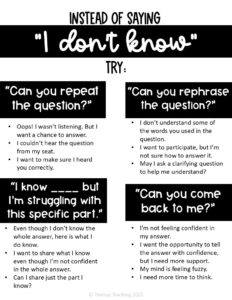
Don't Accept "I Don't Know"

I do not allow my students to give “I don’t know” as an answer to a question that I ask them. Here are some pre-scripted answers I give them as an alternative:

  • Can you repeat the question? 
  • Can you come back to me after I’ve heard some other answers? 
  • My best guess is…
  • I know this part of the answer, but not the specific part you’re asking.

Wait for the Fully Correct Answer

Tell me if this sounds familiar…

Teacher: What is an improper fraction? 

Student: It’s a fraction that has a bigger top number. 

Teacher: Yes, it’s a fraction with a numerator larger than the denominator. 

The problem here is that all the student heard in response to their answer was, “yes”. But it wasn’t fully correct. The teacher did the bulk of the thinking here.

But what if it went like this instead. 

Teacher: What is an improper fraction? 

Student: It’s a fraction that has a bigger top number. 

Teacher: That is a good start, but it’s not a fully correct answer. Who can add to that? 

Student 2: The top number is the numerator. 

Teacher: We’re getting closer!

Student 3: It’s a fraction with a numerator larger than the denominator. 

Teacher: Yes! Let’s all say that correct answer together. 

What is most popular around here...

Leave a Reply

Your email address will not be published. Required fields are marked *

I help upper elementary teachers like you engage their students with meaningful lessons and ideas without having to spend a lot of time or money.

Learn more about me and how I can help you here.

Hi, I'm Lauren!

I help upper elementary teachers like you engage their students with meaningful lessons and ideas without having to spend a lot of time or money.

Learn more about me and how I can help you here.

Let's Connect!

Get The 5 Steps to Helping Your Students Master the 8 Parts of Speech

Some of the links on this site are affiliate links. This means that at zero cost to you, I will earn an affiliate commission if you click through the link and finalize the purchase.

getting students to think using well-crafted questions